
The Forgotten Ink-Slinging Goodness of H.M. Wilder
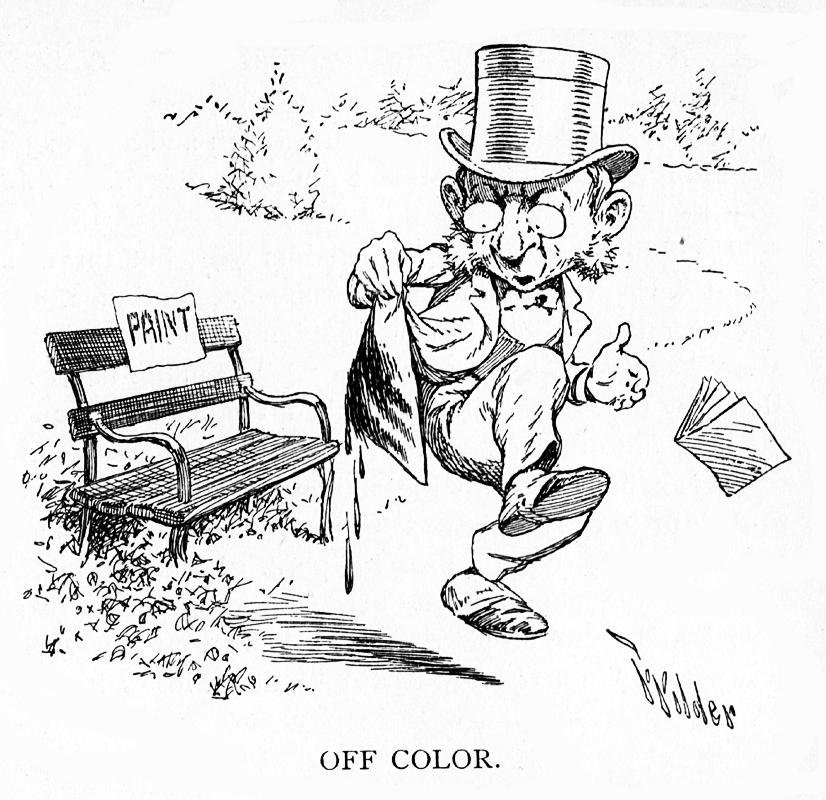
H.M. (Herbert Merrill) Wilder, known as Bert both professionally and to his friends, is one of the great unsung ink-slingers of early magazine cartooning. Wilder was a deft draftsman who incorporated a unique and quirky line style in his drawings, similar to fellow cartoonist-illustrator Will Crawford. Where Crawford played with oddball ink hatching resulting in sometimes awkward textures and shadows, Wilder often incorporated a double contour line into his work, which gave the figures a bit more sense of weight and movement. It’s hard to tell if the line was a result of a split pen nib or Wilder’s going over the contour a second time, but it certainly added a liveliness to his cartoons and illustrations. Wilder was a wonderful figurative artist, much on the order of his contemporaries A.B. Frost and T.S. Sullivant. All three of the cartoonist-illustrators had the ability to capture a figure’s movement at the apex of an action. It’s possible that the three artists were influenced by Eadweard Muybridge’s animal and human locomotion photography, which captured action as never before. Frost was certainly aware of Muybridge’s work, as he had one cartoon specifically commenting on the true ways in which equine anatomy moved. Frost and Wilder in particular, imbued a sense of slapstick in their figure movement, due in large part to that figural exaggeration in the midst of action.
Wilder was born in Hinsdale, New Hampshire in September 1865. Wilder’s father was a blacksmith in Hinsdale, who later became a banker and Justice of the Peace. H.M. Wilder was a member of the library committee in town, and it was noted by a former city clerk, Eleanor Smith, that the town may own a charcoal drawing of Abraham Lincoln by Wilder. In a nutshell, H.M. Wilder contributed to many of the top publications of the day. He produced work for Harper’s Weekly for many years, and the magazine sent Wilder to the Paris Exposition in 1900. He was also a frequent contributor to Life, Puck and Judge, among other publications. Wilder also illustrated “The Voyage of the Rattletrap”, an 1897 book written by Hayden Carruth.
When Wilder passed away on February 1, 1915, there was scant coverage of his passing, mostly short boiler plate obituaries that ran in east coast newspapers. An obituary that ran in The Brattleboro Reformer on February 20, 1915 gave the most fulsome picture of Wilder’s life. It is presented here in its entirety, grammatical quirks and all:
A FAMOUS CARICATURIST
Career of a Cheshire County Boy, Herbert Merrill Wilder.
The death of Herbert Merrill Wilder, a Cheshire County boy who achieved distinction early in his career, deserves more than a passing notice.
As a Hinsdale school boy Mr. Wilder displayed marked talent in drawing combined with a keen sense of the humorous side of life which naturally turned his attention to caricature. His work was of such quality as to find a ready market and, even before leaving home for study, he furnished drawings regularly for a commercial publican in Boston, which attracted attention. At this time he made some drawings for “The Student”, which was published in Keene for a short time.
While still in his teens, he went to Boston for study and entered the museum of fine arts and later he studied at the Cowles Art school. As a student he made drawings for different publications and he was soon engaged by the Beacon, with which he remained a number of years.
After several overtures from the Harpers, Mr. Wilder joined their staff and removed to New York, which was ever after his home. At that time the Harpers employed the most famous illustrators in the country, such as Edwin A. Abbey, C.S. Reinhard, T. de Thulstrup, W.T. Smedley, A.B. Frost and Frederick Remington, and the connection, which continued for many years, was a very flattering one to the young artist. His work appeared in all the Harper periodicals and an occasional book was illustrated by him. With Julian Ralph and Charles Graham he made a coaching trip through the west country of England and he furnished many entertaining sketches for the volume with described the journey. His work was always welcomed by Life and he was an occasional contributor to Puck, Judge and other publications.
Increasing ill health interfered with his production, although after a period of inactivity spent with his brother he had returned to New York to resume his work a short time before his death.
Although of a retiring nature Mr. Wilder was a genial companion and popular with his friends, of which he enjoyed a wide circle during his best years. His work was conscientious, a word little associated with caricature of the present day, yet it gave no suggestion of the thought and care expended upon it, though the skill of the draughtsman was always evident. Little did those who enjoyed the excruciatingly funny products of his pen realize the labor expended up them. A drawing which did not satisfy him was thrown aside and a second, and sometimes a third, completed before it met with his approval.
– “L” in Keene, N.H., Evening Sentinel
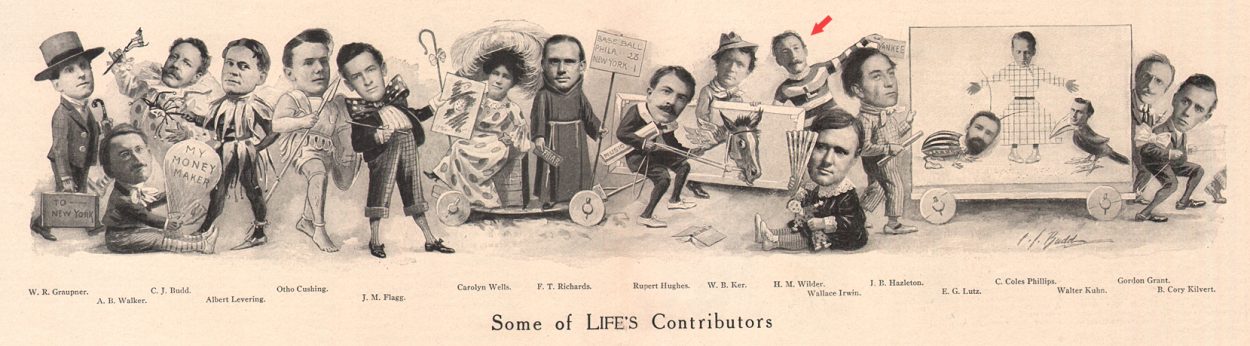
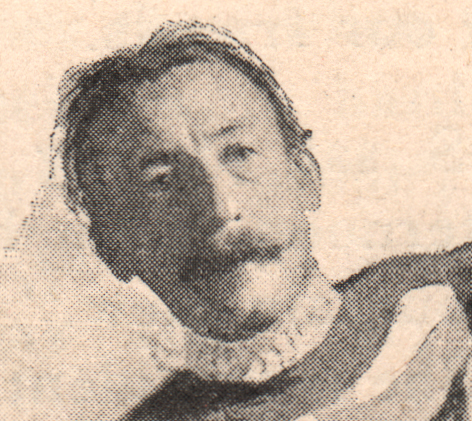
There are no known photographs of H.M. Wilder. The only known (at least to me) portrait image of Wilder appeared in the December 9, 1909 issue of LIFE. Illustrator C.J. Budd masterfully depicted a whole host of contributors to LIFE, including the elusive Mr. Wilder. One of the images appears as the top banner to this post. Here’s a detail shot of Bert Wilder, with thanks to Leo De Sá for pointing the images in the magazine out to me:
As the obituary mentions, Wilder moved to New York City early on to work for Harper’s Weekly. Below is a cartoon of his that was published on May 5, 1895.
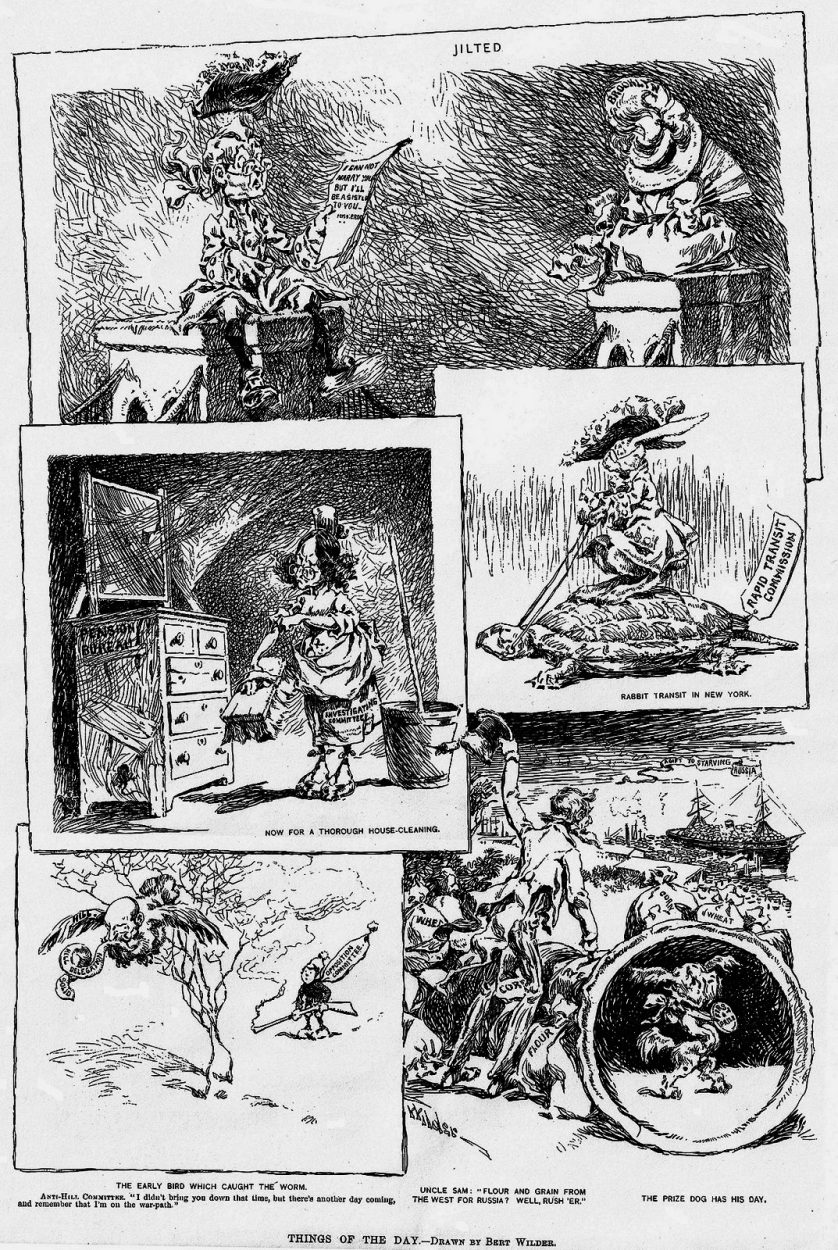
Titled “Things of the Day”, the cartoon presents a montage of political issues of the day. You can see that Wilder is honing his artistic voice, incorporating rich shading textures to set off the figures and the scenes. I’m particularly struck by the top panel, labeled “Jilted”, with those rich hatching and cross-hatching lines laid down in a seeming organic fashion, all the while creating a rich solidity to the scene. This is not yet Wilder’s mature work, but it’s coming soon.
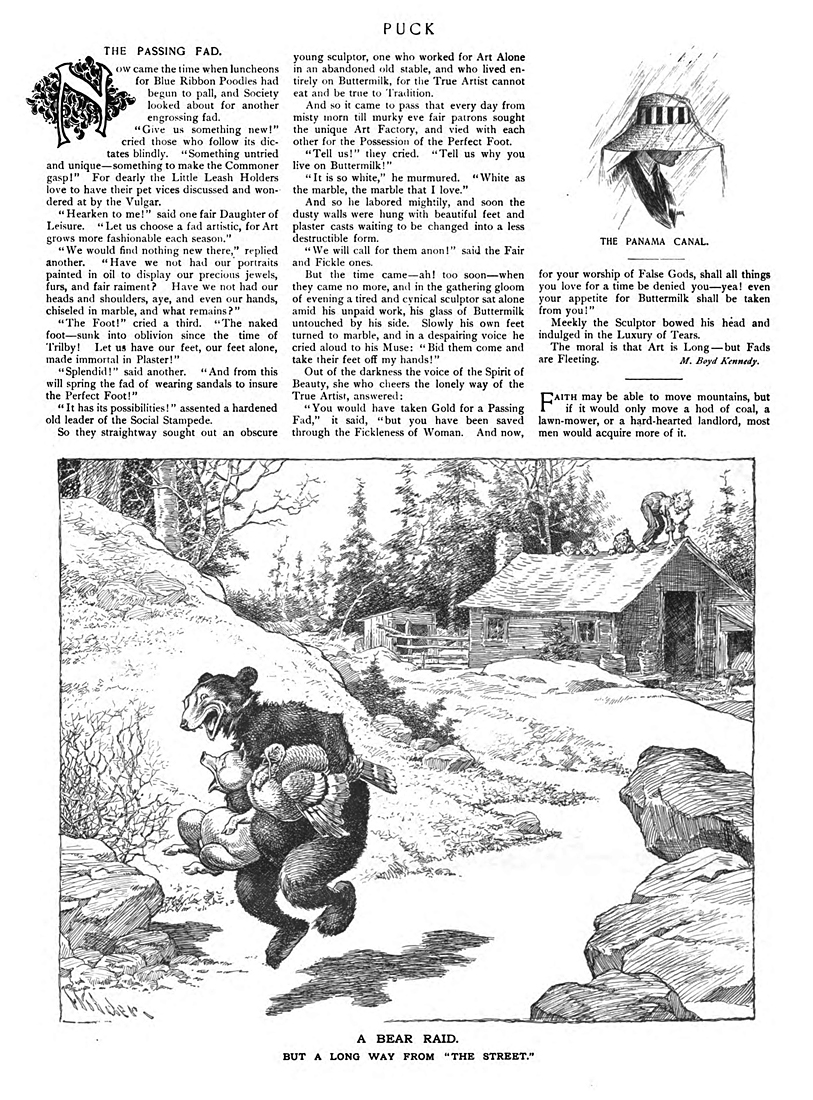
The cartoon below, titled “A Bear Raid” appeared in the September 25, 1912 issue of Puck magazine. This is work from Wilder’s best period, with that deft pen line of his creating joyous movement throughout the work. The cartoon is captioned “But a Long Way From ‘The Street'”.
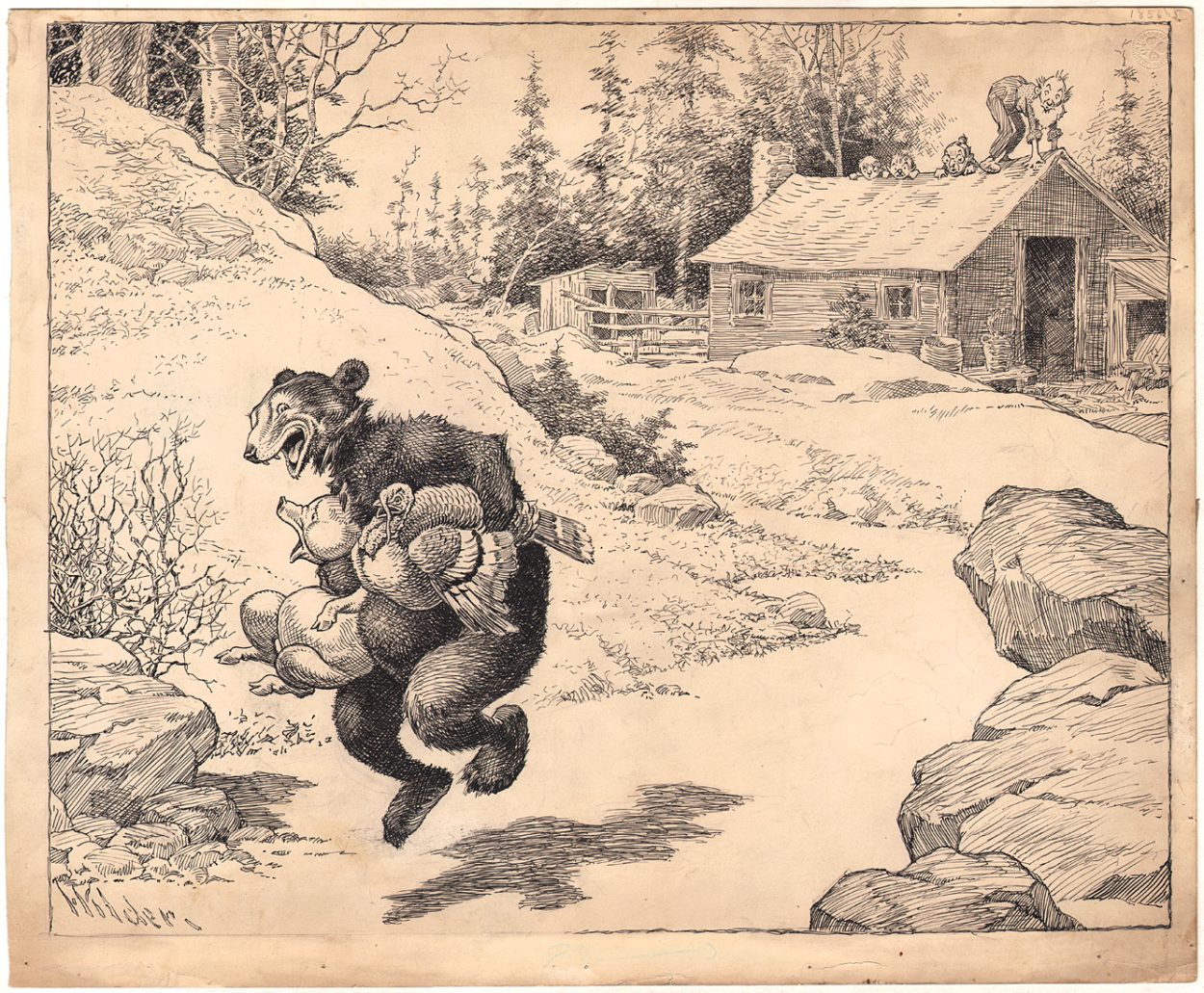
While not a knee-slapper of a gag, this cartoon, shot from the original artwork, features Wilder’s wonderful use of exaggerated figural movement, terrific textures and just beautiful ink-slinging. You’ll note how he varies the shading from gentle and sporadic hatching, to rich, organic cross-hatching. The cross-contour pen work on the bear, pig and turkey are superb.
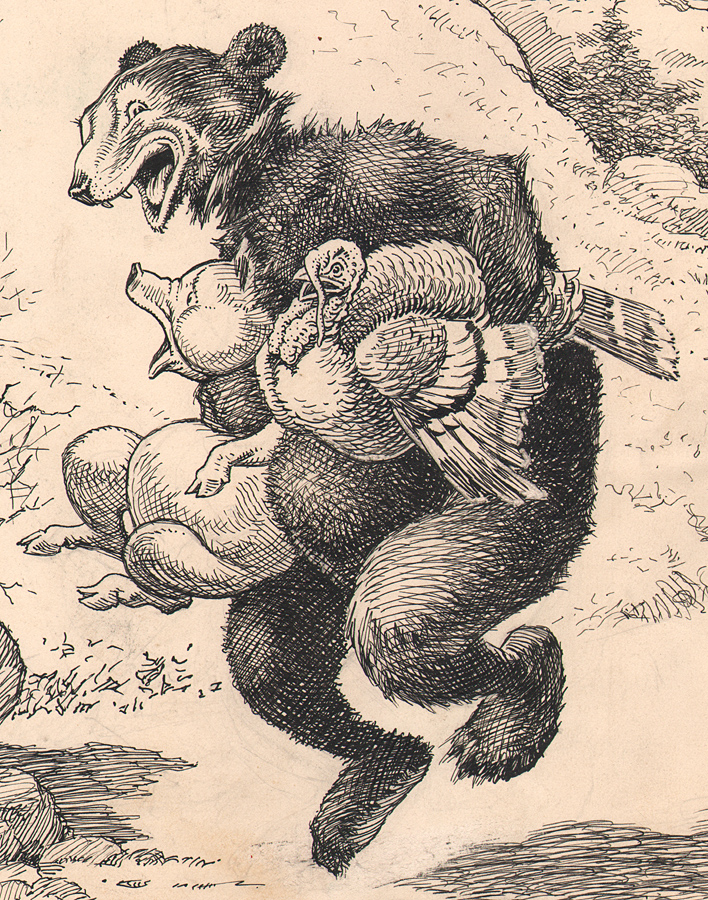
I mean, c’mon, look at this gorgeous ink work. Wilder managed to create a drawing that has so much weight, lightness and joy, all at the same time.
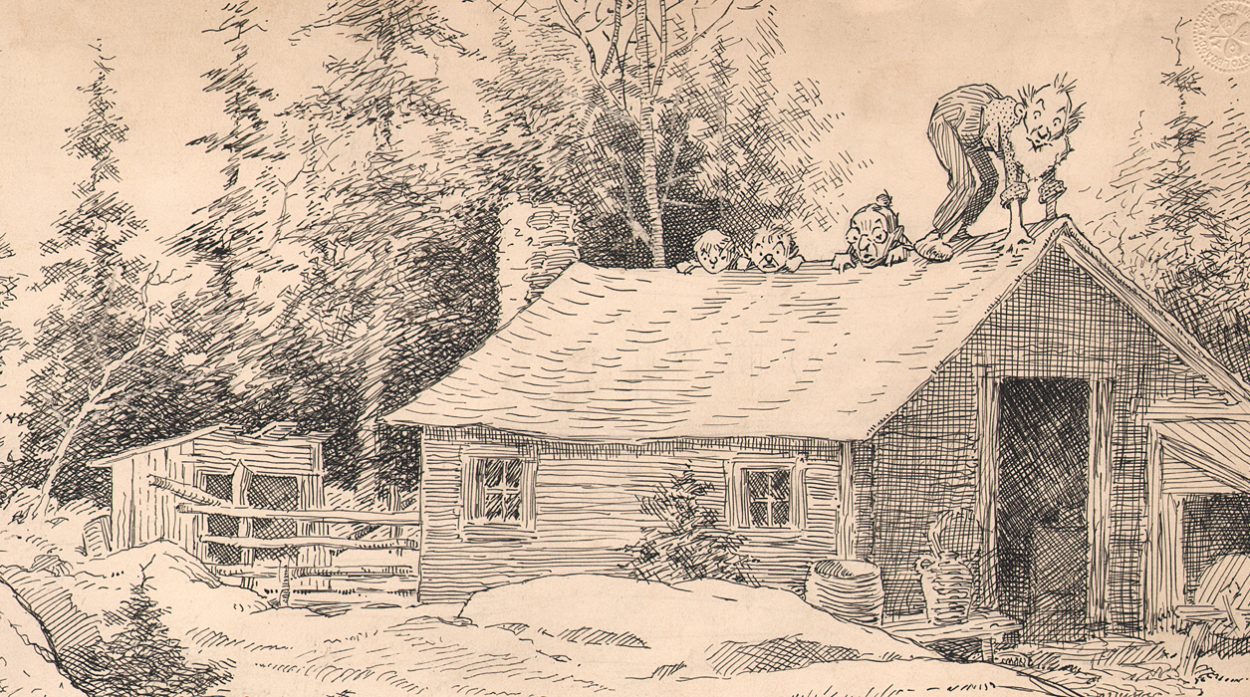
Even the background imagery was drawn with a beautiful lightness of touch, all the while maintaining a weight in the figures, structures and landscape.
Below is the published version of the cartoon.
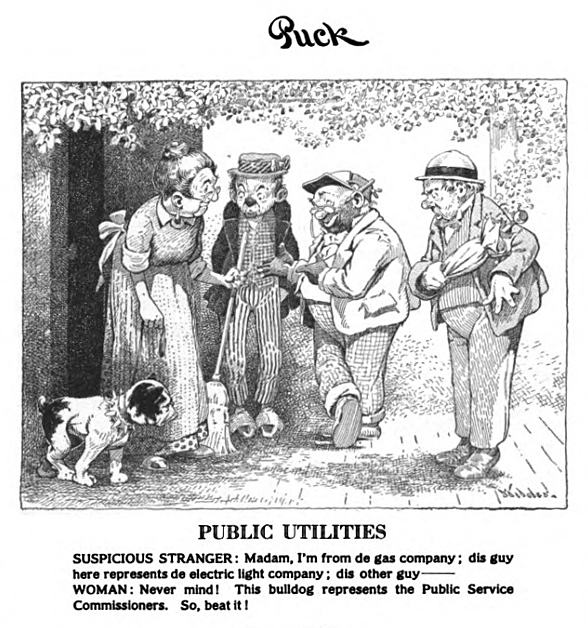
The following cartoon, titled “Gentle Sleep”, appeared in the May 14, 1913 issue of Puck magazine. As you can see, the original has seen better days over the past 113 years, but Wilder’s original are incredibly scarce, so you take what you can get.
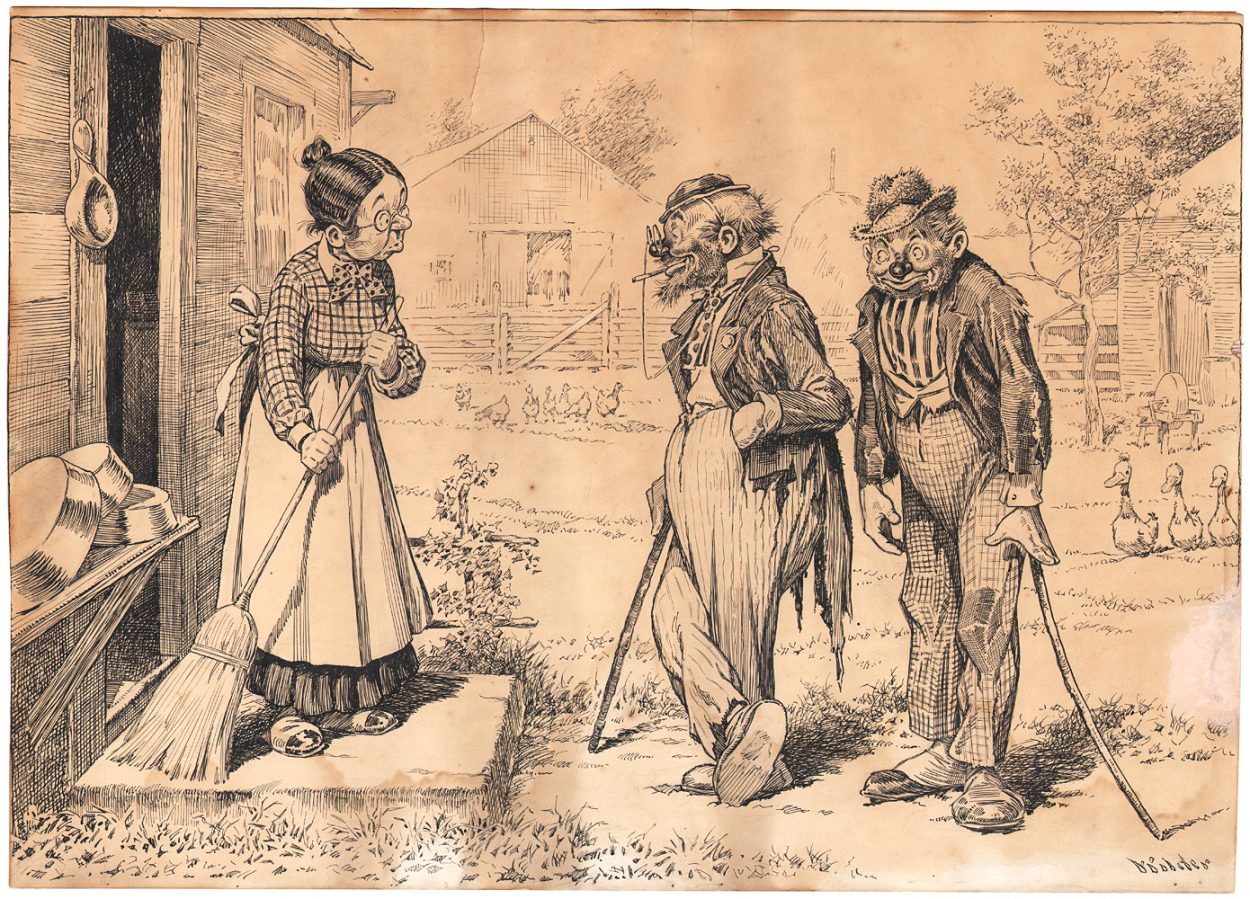
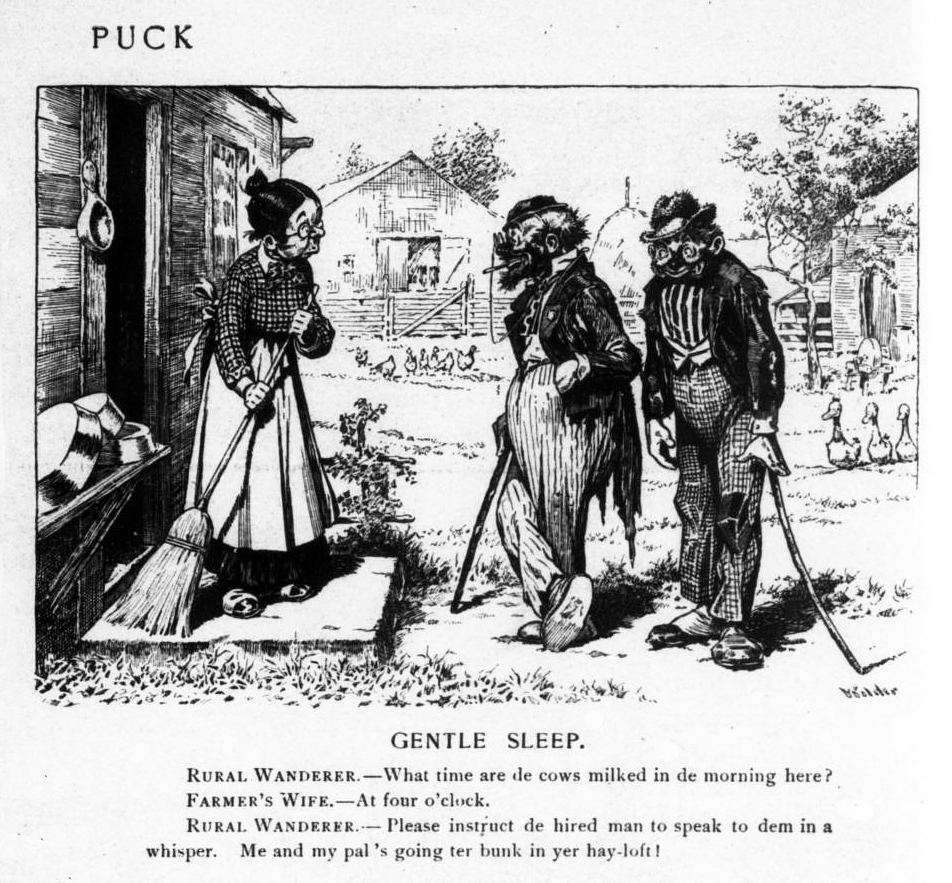
The piece had dialogue accompanying the cartoon:
RURAL WANDERER – What time are de cows milked in de morning here?
FARMER’S WIFE – At four o’clock.
RURAL WANDERER – Please instruct de hired man to speak to dem in a whisper. Me and my pal’s going ter bunk in yer hay-loft!
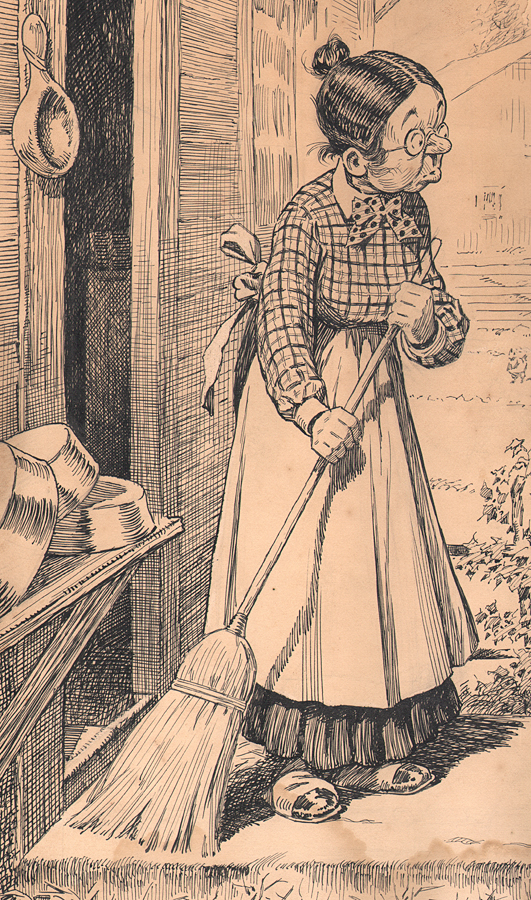
This isn’t Dickens-level writing here, but luckily for us, the artwork carries the day. I’m particularly struck by Wilder’s ability to work between a strong solidity of forms versus his light touch in the background elements. The woman with the broom, as you can see in the detail below, is statuesque in terms of solidity. She’s like American Gothic before Grant Wood ever conceived of his painting. Then you have this wonderful, delicate pen work in the space, forming the trees, barns and those cute-as-hell ducks.
And here is the poor-quality printed version of the cartoon:
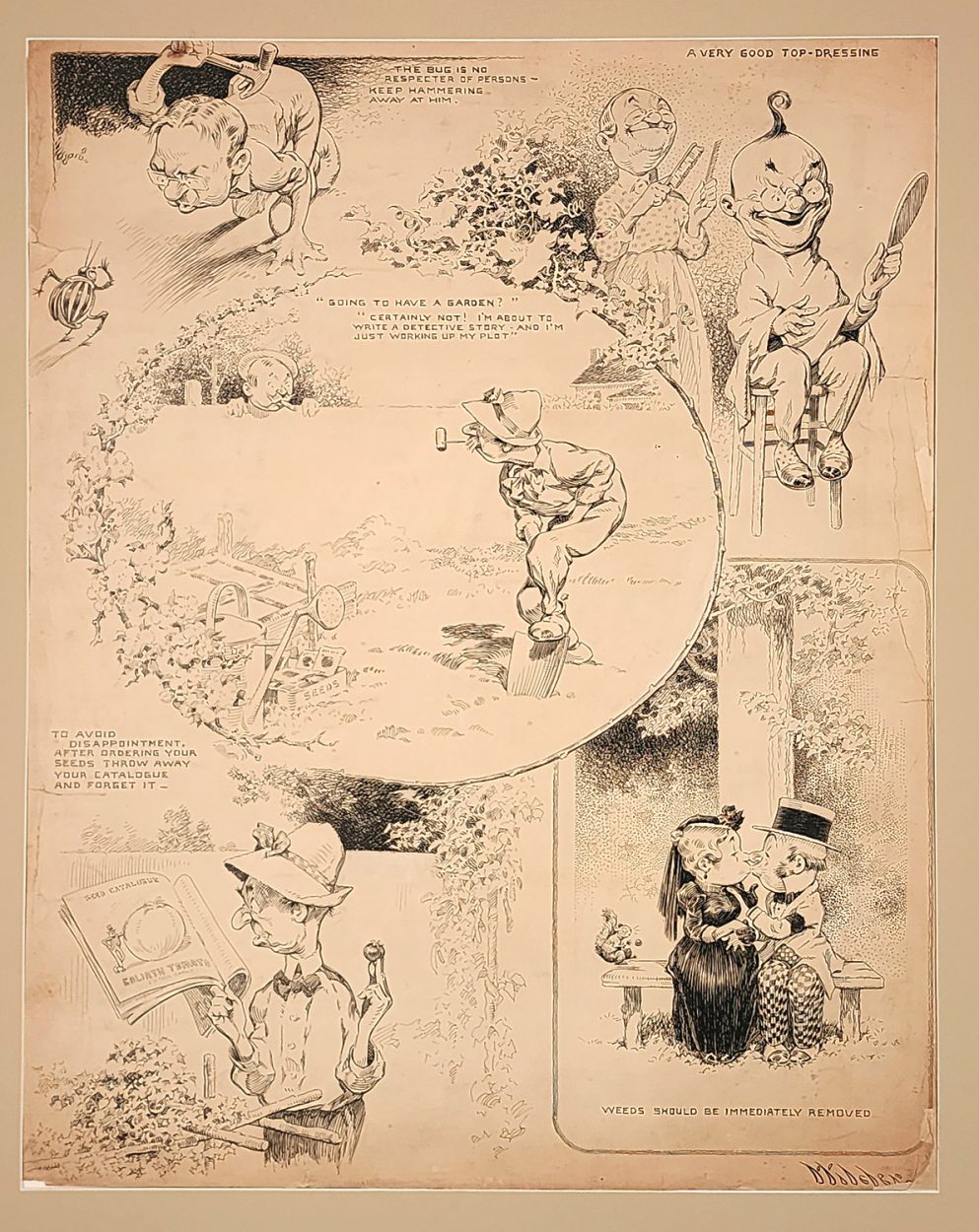
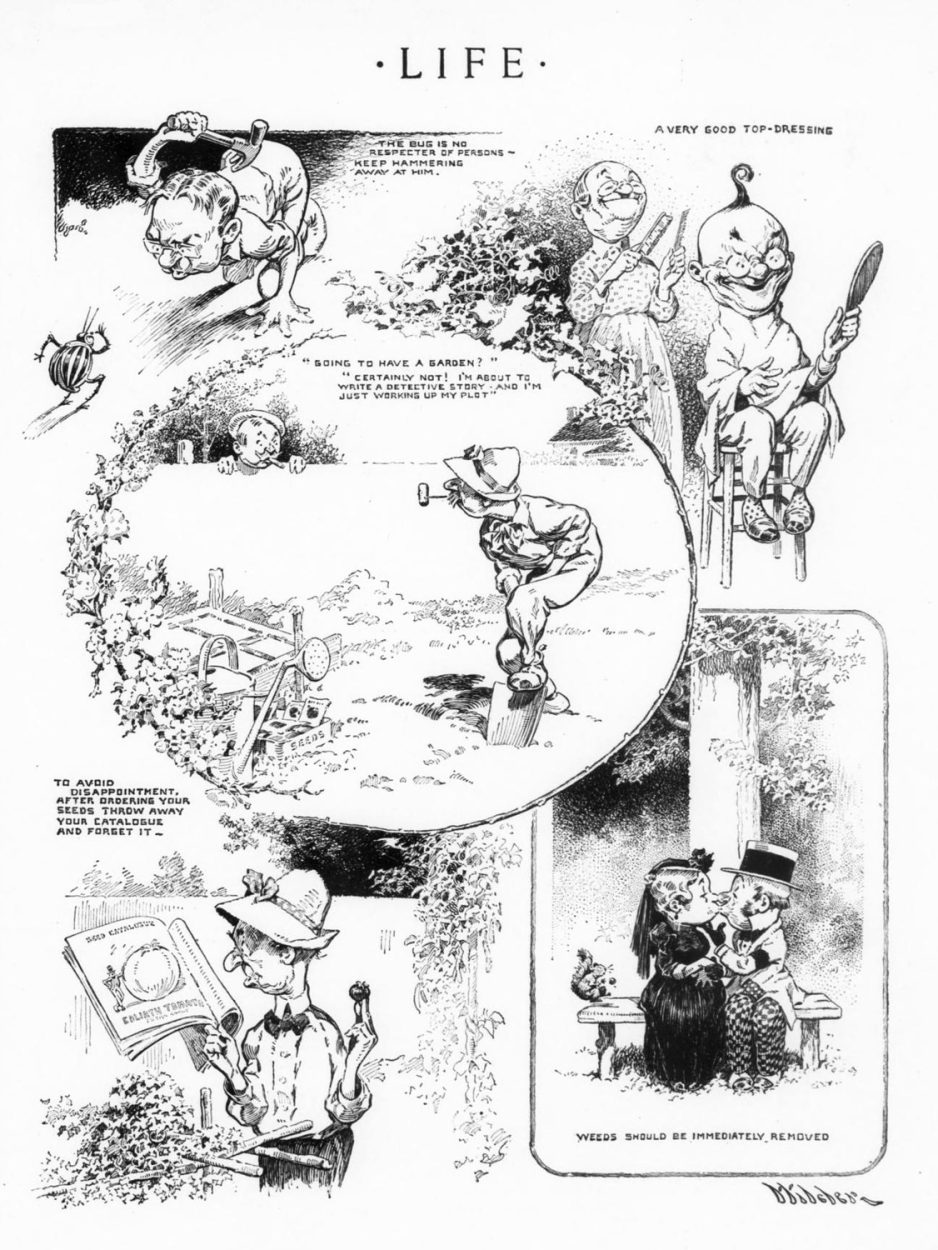
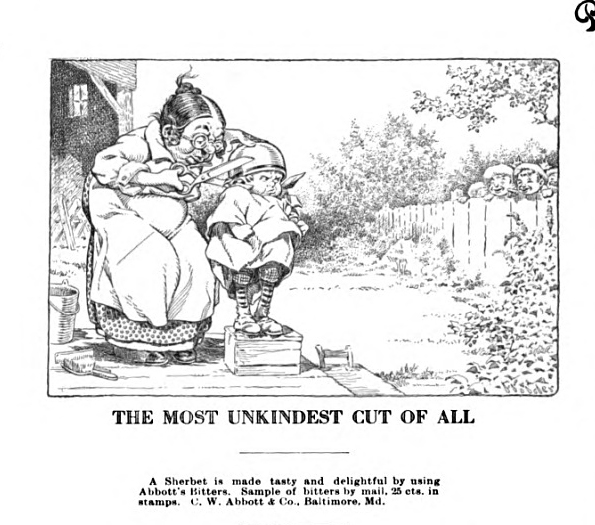
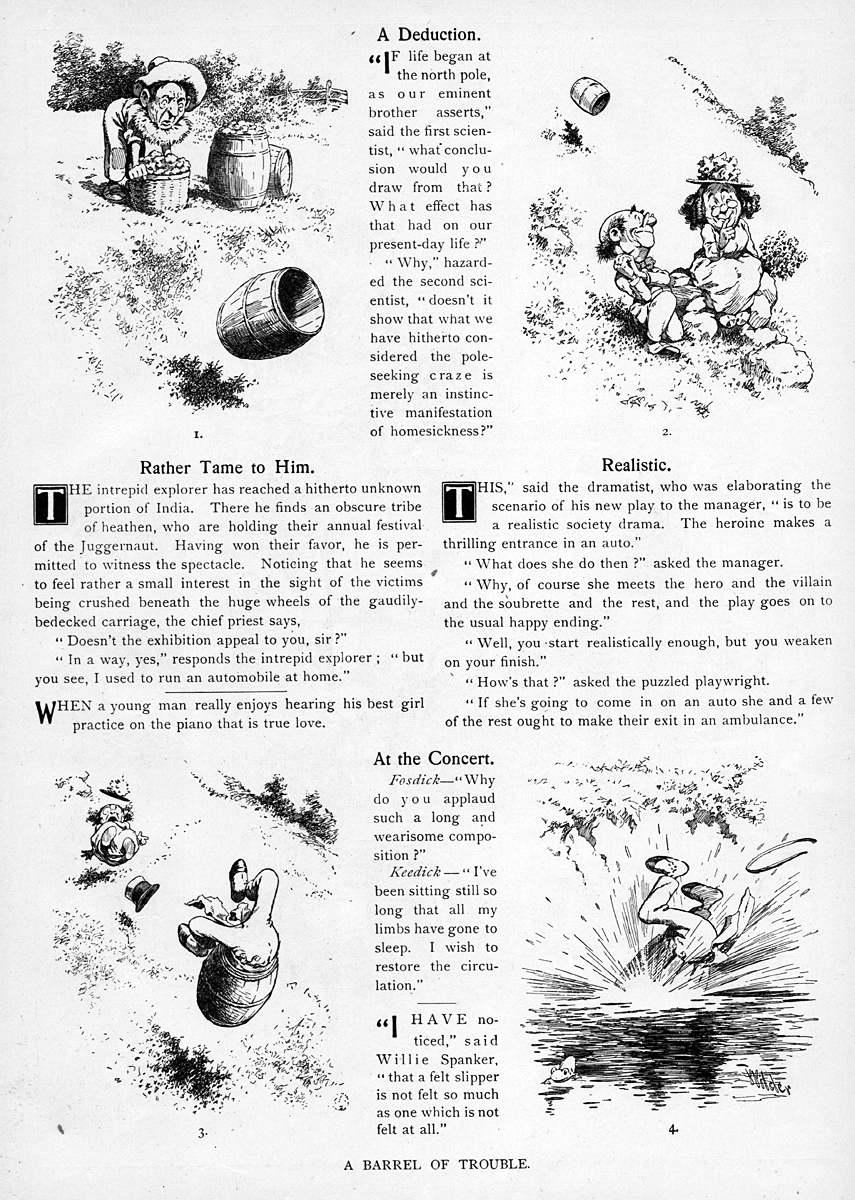
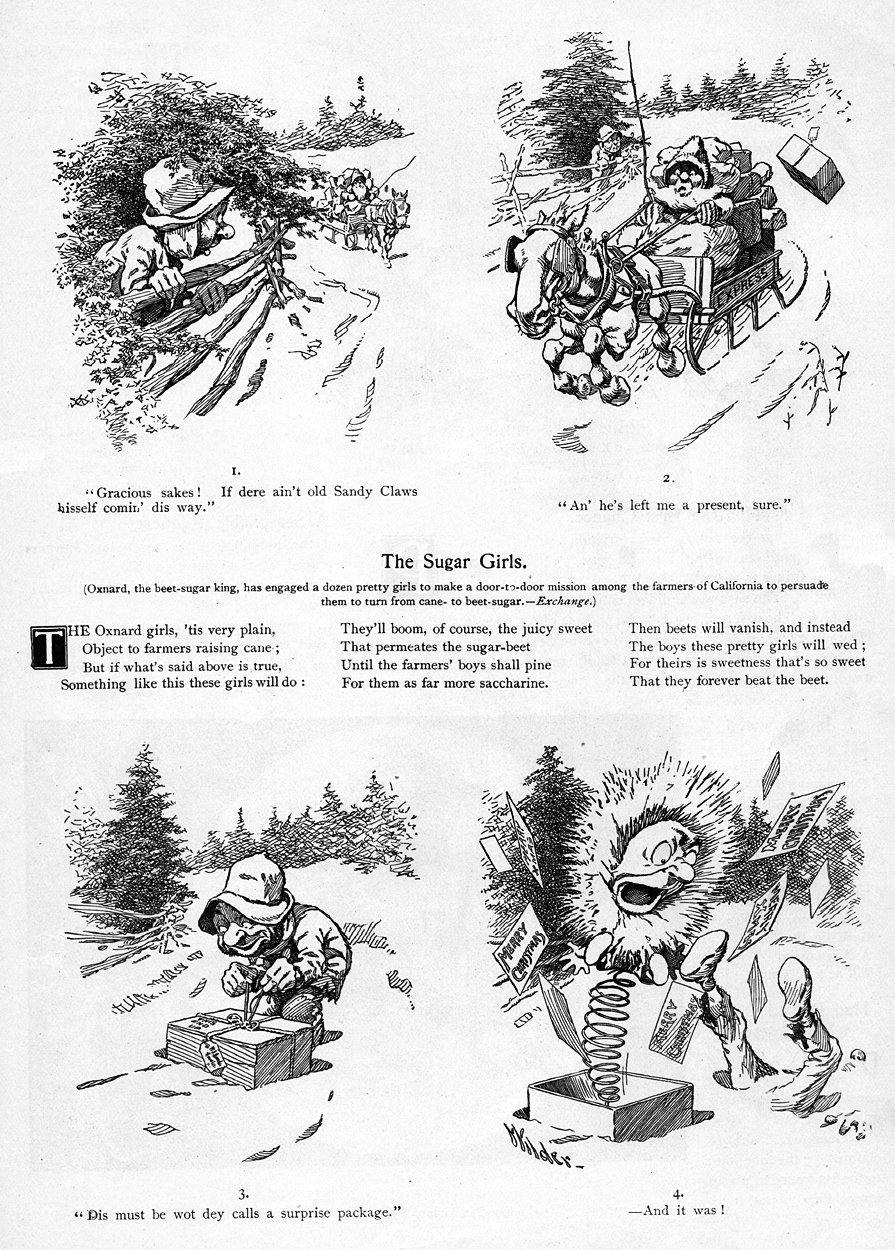
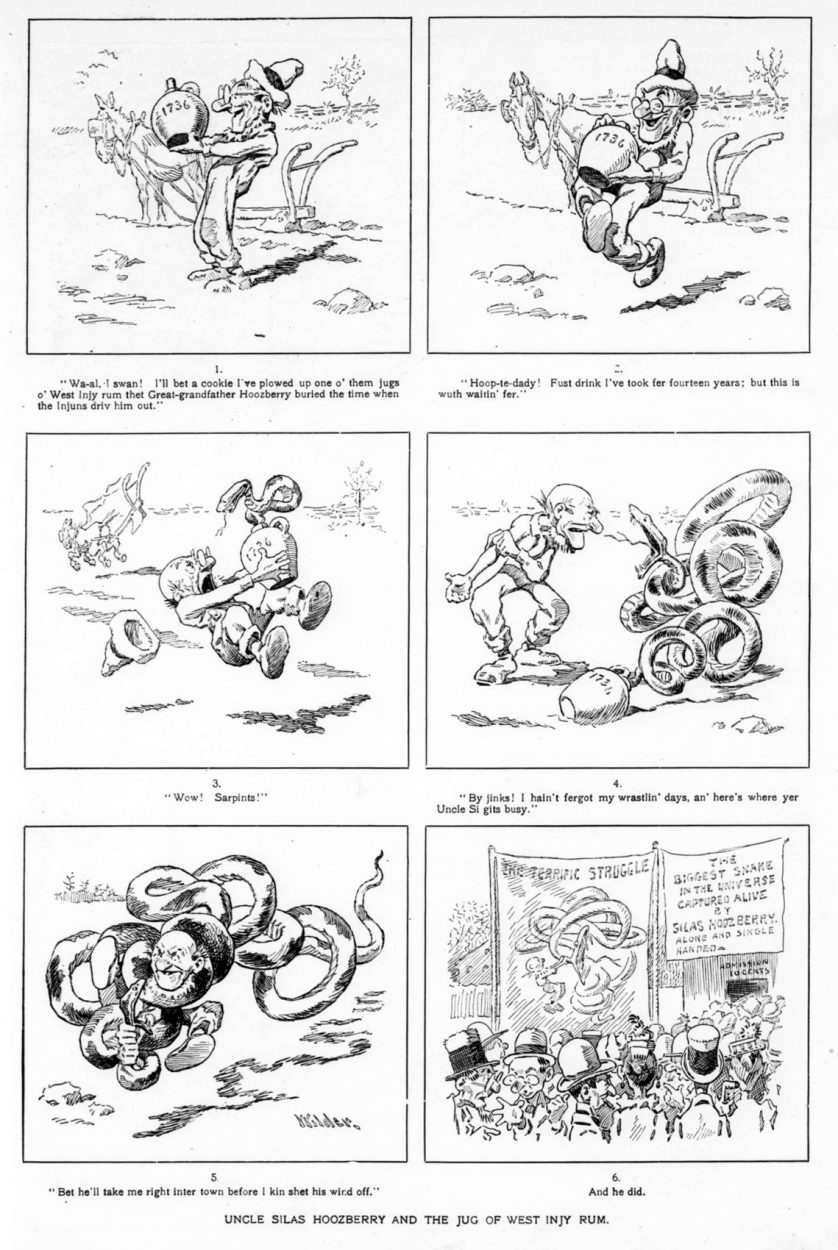
Throughout his career, Wilder drew both single and multi-panel cartoons for the three main humor publications. Sometimes the multi-panel cartoons were contiguous and other times they ran in the corners of one or multiple pages, with humorous stories and jokes in-between them. Below is a selection of such cartoons.
First off is a lovely original drawing from the July 6, 1911 issue of LIFE magazine, followed by the printed version of the piece:
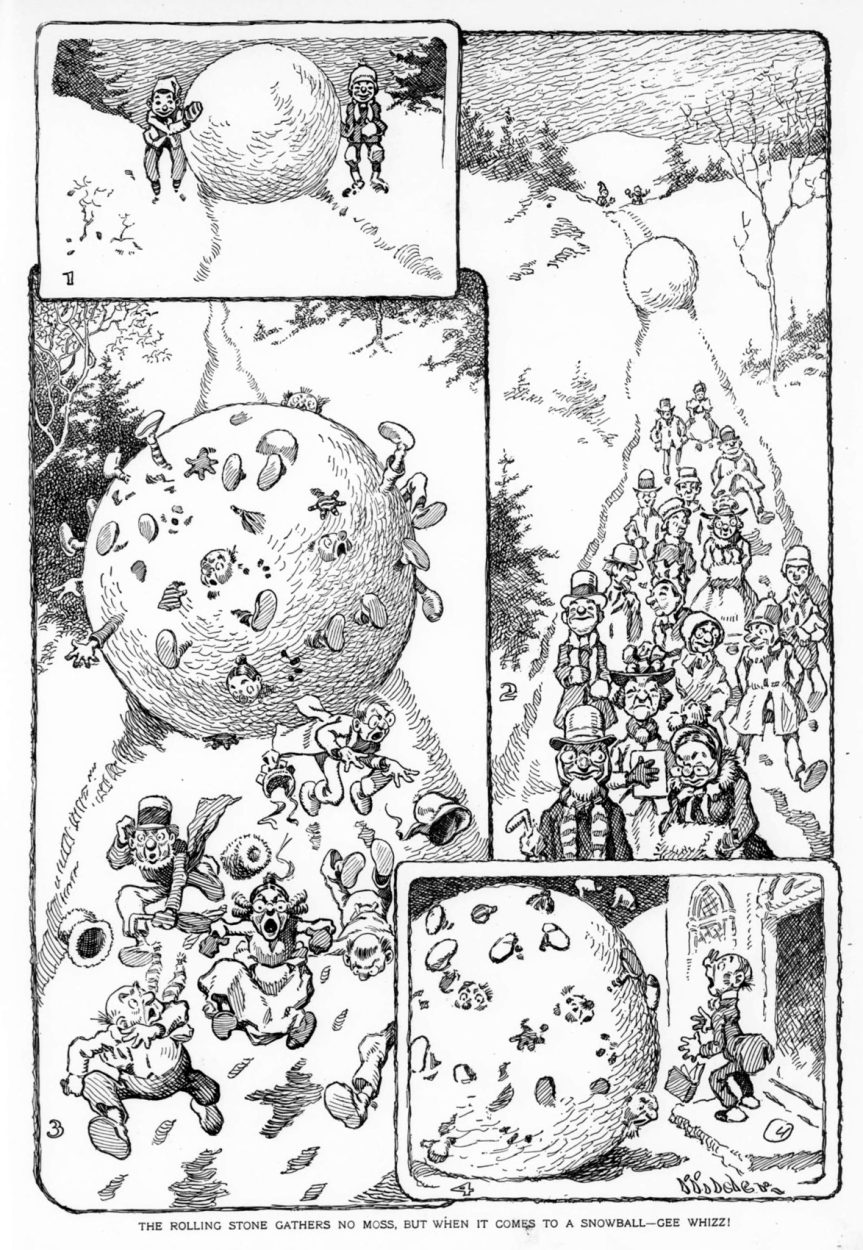
The piece above appears to be influenced somewhat by the late Gus Dirks, who died four years before this piece was published. Dirks was known nationwide for his wonderful Bugville cartoons. Wilder has incorporated some Dirks-like hatching in this cartoon, particularly in the snowball. It’s also an interested layout for a multi-panel magazine cartoon, which usually used a standard grid for the panels.
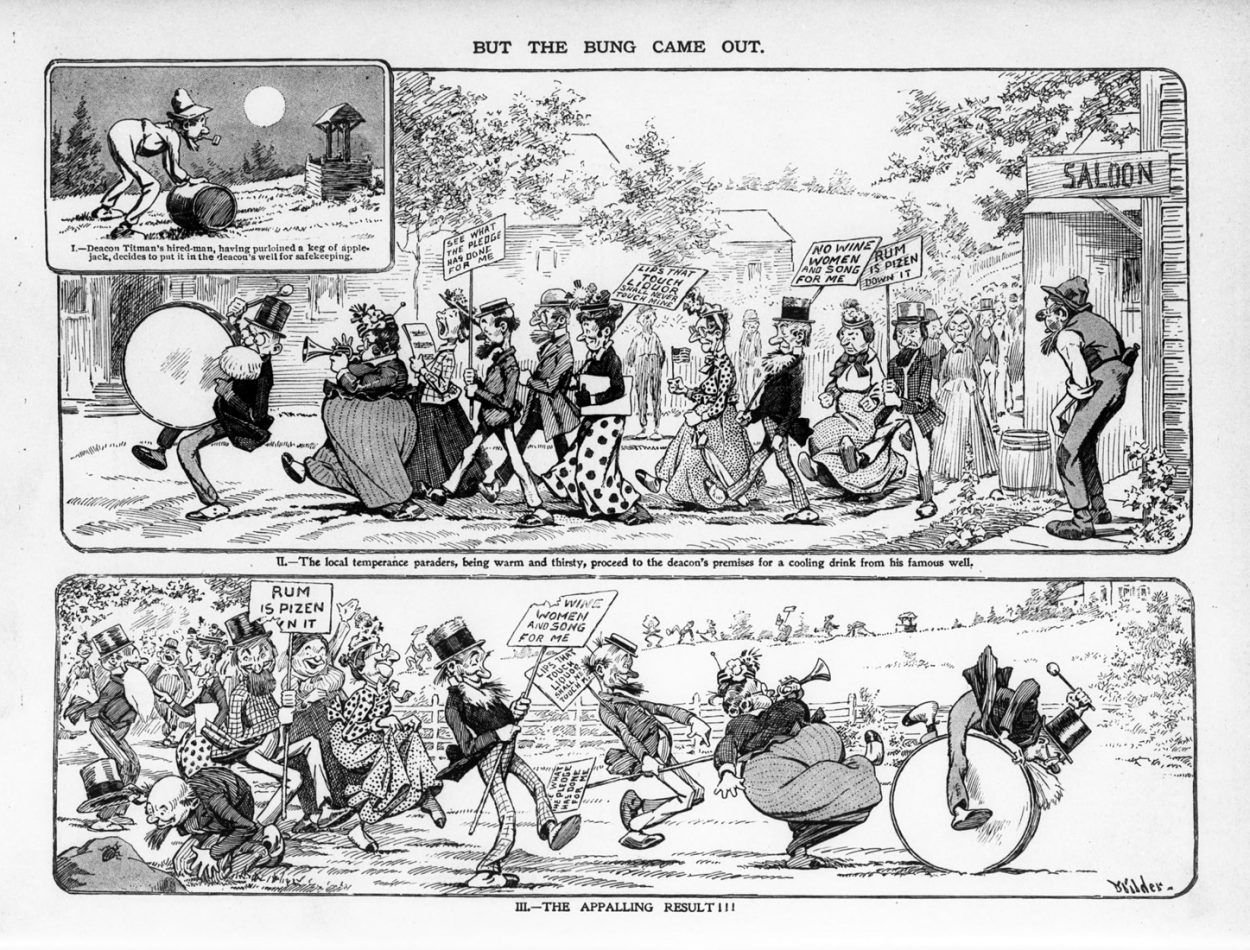
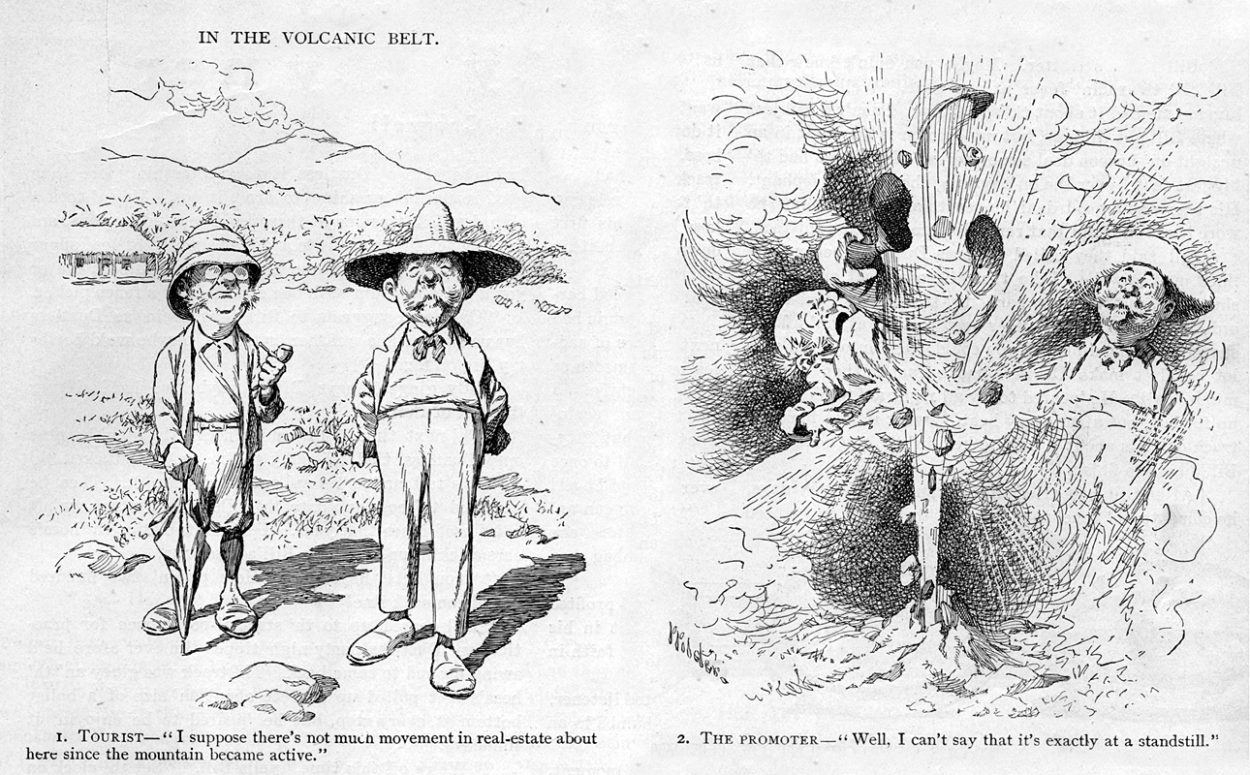
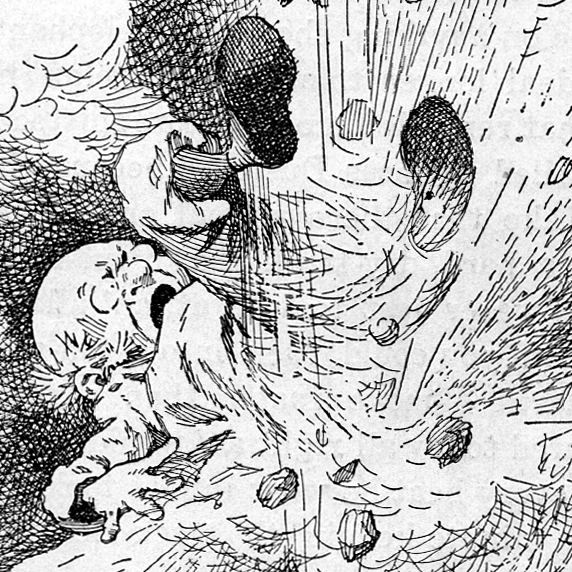
This is such a wonderfully weird little cartoon, literally going from a standstill to full-on action. Check out the detail of that second panel:
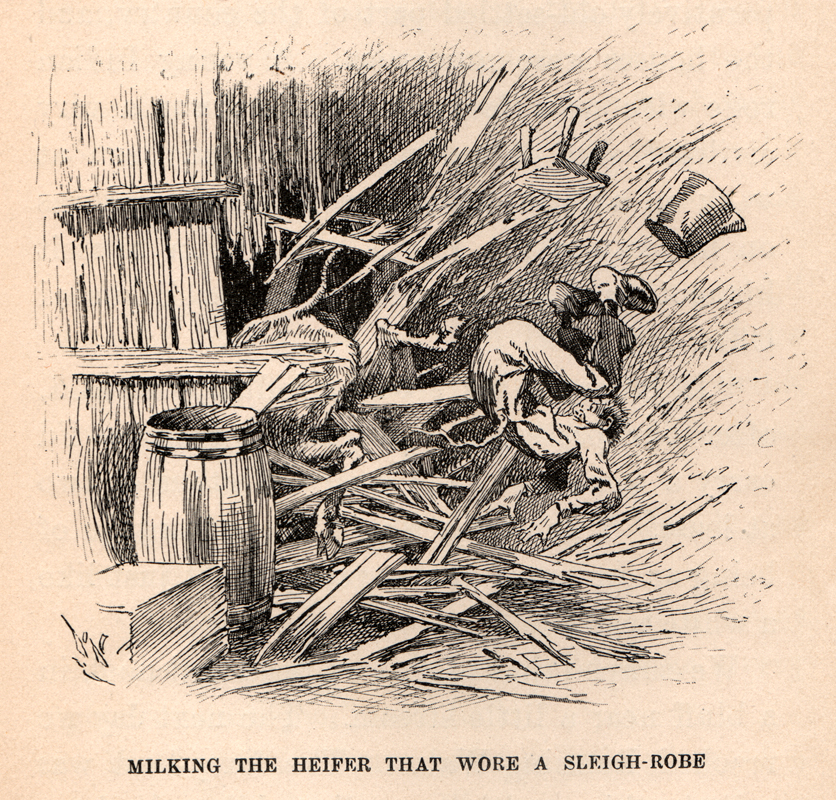
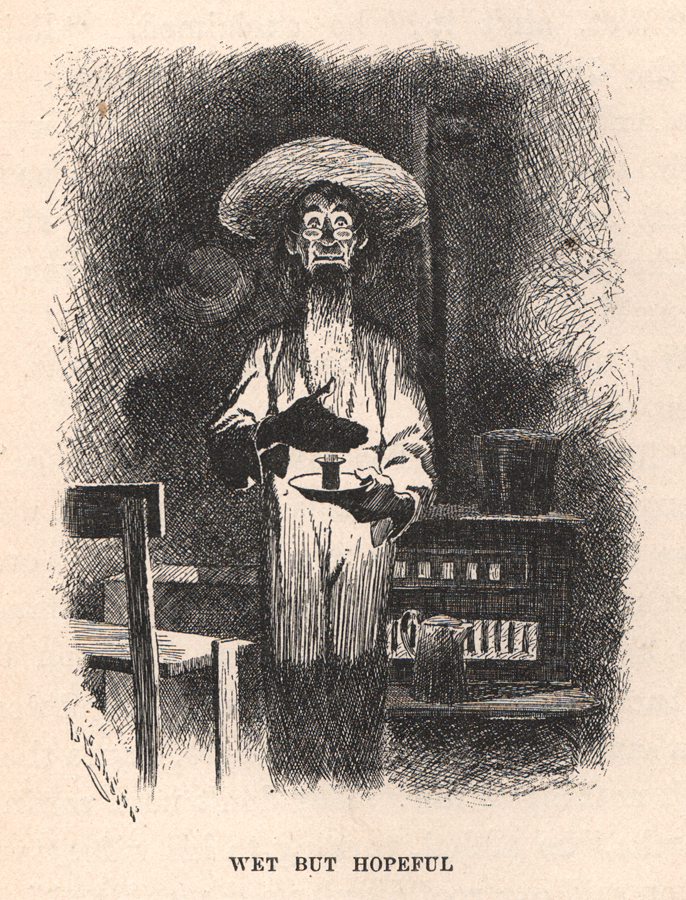
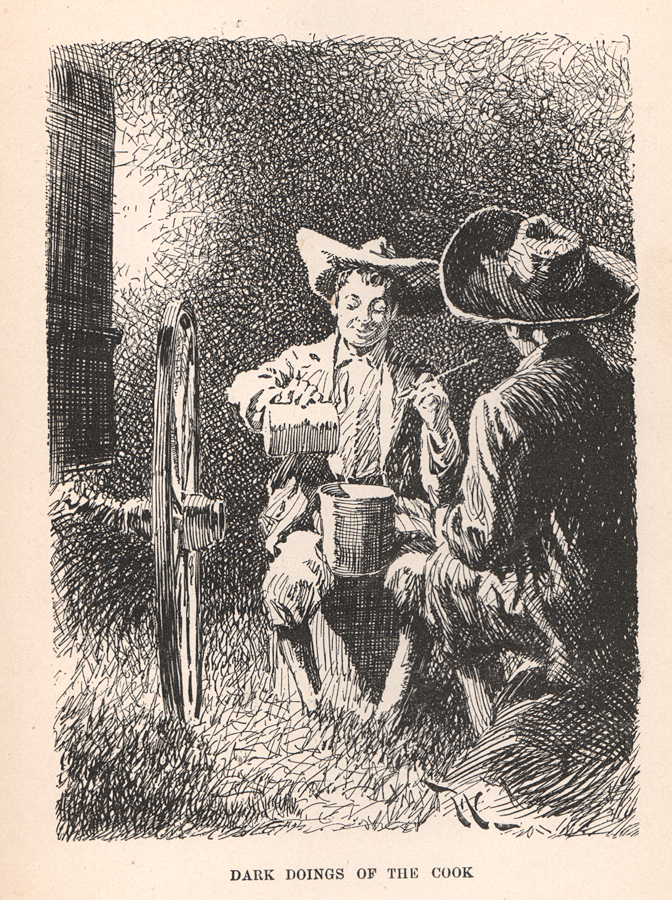
I mentioned “The Voyage of the Rattletrap” earlier on this post. The book relates the story of three young boys and a stray dog named Snoozer, as they explore the untamed Dakota Territory in a prairie schooner they have dubbed The Rattletrap. Wilder seems to have pulled out many of the stops in the illustrations for this book, with wild and wonderful action supported by his lively pen line. I’ve already pictured one of the illustrations. Below are more of the pieces from the book.
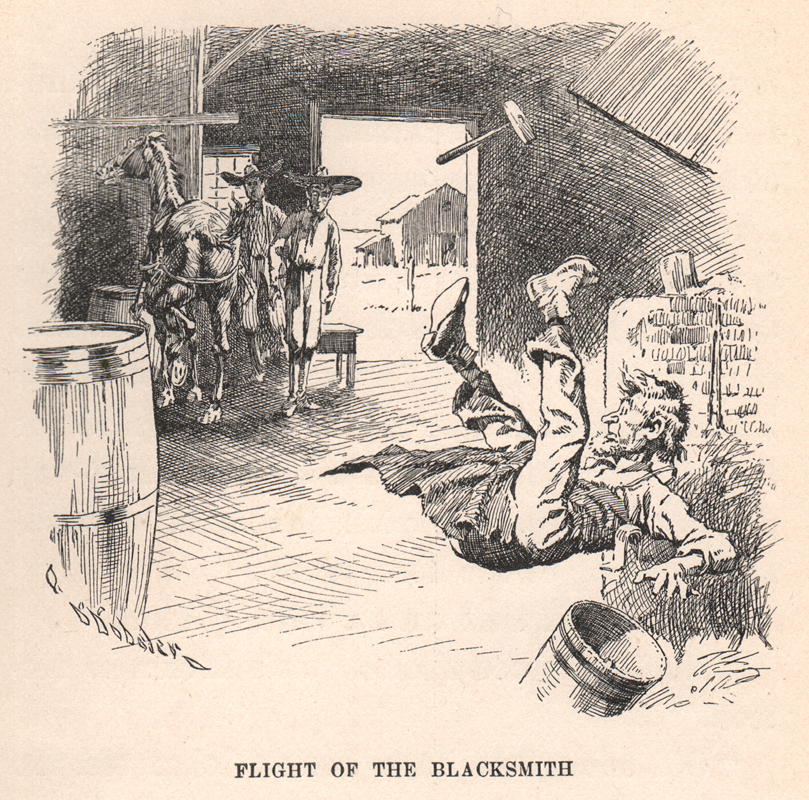
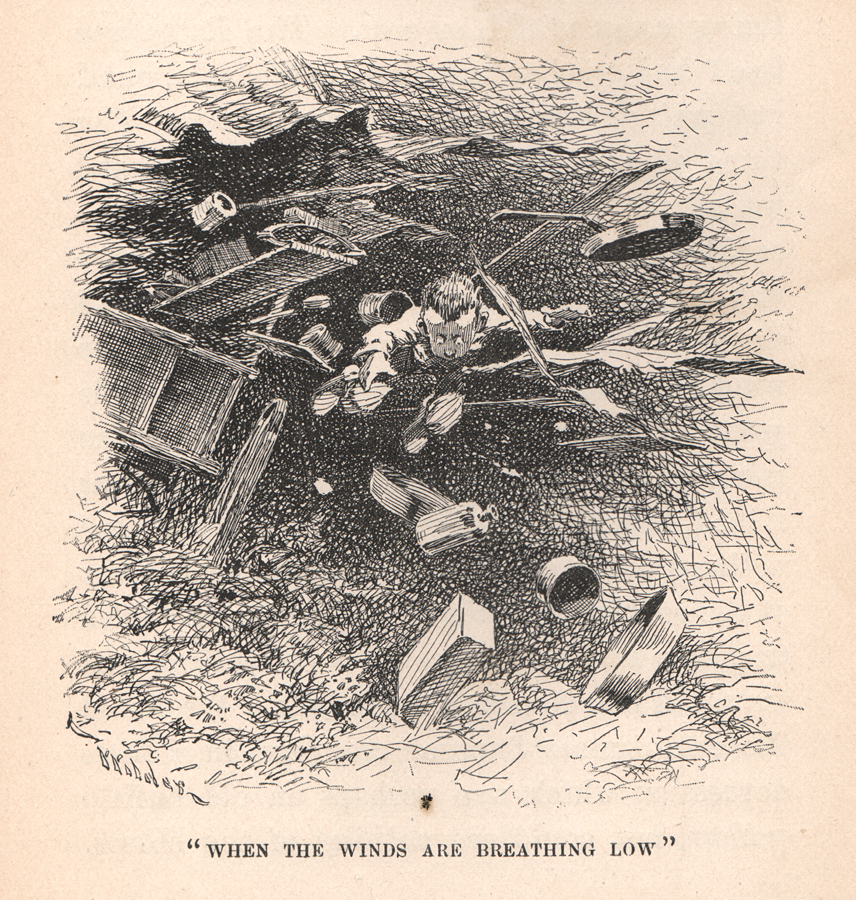
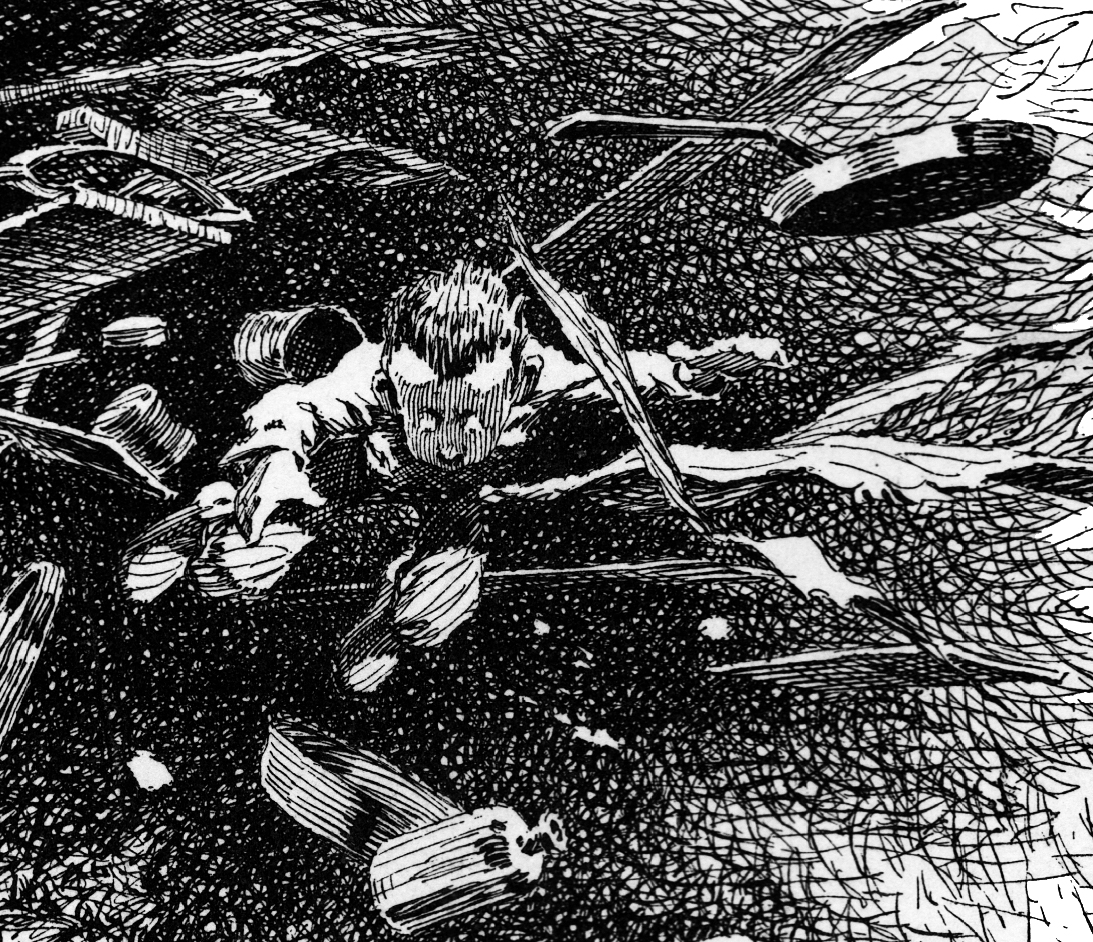
Check out the insane detail on the above piece:
1915 was not a good year for American magazine cartoonists. First we lost H.M. Wilder, and then in June, Raymond Crawford Ewer passed away. Both men were at the height of their careers, taken from the world much too soon. Crawford is well-known for his run on Slim Jim and the Force, but many of his magazine cartoons, like Wilder’s, were magnificent. Someday in the not-too-distant-future, Ewer will appear in this blog as well. In the meantime, it is my hope that shining a bit of light on the forgotten work of H.M. Wilder will help give him the bit of acclaim that he deserves.
If anyone is interested in high and low resolution scans of the Some of LIFE’S Contributors feature, you can download them from my pCloud account here.
Many thanks for tuning in. Until next time, be well.

Rob Stolzer
Rob Stolzer has been collecting original comic strip and cartoon artwork for over 40 years. He has written numerous articles for Hogan's Alley, the CFA-APA and other journals. Stolzer taught art at the University of Wisconsin-Stevens Point for 33 years, where he taught Art Seminar, Drawing, Figure Drawing, Graphic Narration, Illustration, and Painting courses.
2 Comments
Steve Smith
Fantastic, Rob. Wondrous stuff. The close-up insets are especially helpful to show the care and and imagination he brought to his facial expressions. Thanks for calling attention to him.
Michael Rhode
Great detective work. thanks for sharing!